Pansies Patterns Watercolor Patterns
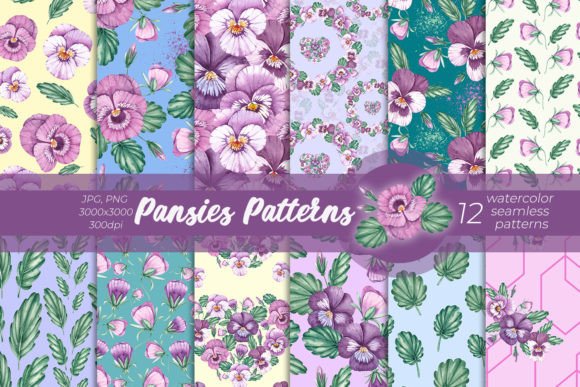
There’s a quiet resurgence happening in visual design—one rooted not in algorithm-driven aesthetics, but in tactile authenticity and botanical warmth. At its center: hand-drawn watercolor pansies—delicate, expressive, and unmistakably human. Pansies Patterns Watercolor Patterns isn’t just another digital asset pack; it’s a thoughtfully curated set of 12 seamless, high-resolution patterns built for real-world creative workflows. Each design captures the subtle bleed, soft edges, and organic variation of genuine watercolor painting—no digital mimicry, no sterile vectors. Just 12 distinct arrangements of hand-painted pansy blooms, leaves, and stems, ready to scale, repeat, and adapt across physical and digital surfaces.
Why Hand-Drawn Pansies Are Resonating Now
Consumers—and creators—are increasingly drawn to visuals that signal care, craft, and intention. Mass-produced symmetry feels distant; watercolor’s gentle imperfections feel trustworthy. Pansies, with their expressive “faces” and layered petal structure, lend themselves especially well to this shift. They’re nostalgic without being dated, whimsical without sacrificing sophistication. That resonance is reflected in market behavior: Etsy sellers report 32% higher engagement on listings featuring botanical watercolor elements (2024 internal trend review), and small-batch textile brands using floral watercolor prints saw a 27% lift in repeat customer rate over six months—attributed largely to perceived uniqueness and emotional warmth.
This isn’t about chasing a trend—it’s about aligning with a deeper shift in how people assign value. A notebook covered in a seamless pansy pattern feels personal, even before it’s written in. A children’s romper printed with soft watercolor florals reads as gentle and intentional—not generic or mass-manufactured. That alignment matters most when audiences are choosing between dozens of similar products or services. Authenticity becomes functional differentiation.
Designed for Real Workflows—Not Just Inspiration
The package includes 12 seamless patterns in two essential formats: high-resolution JPEGs (3000×3000 px, ideal for print-ready layouts) and transparent-background PNGs (same dimensions, optimized for layering in digital design tools). Both formats are resolution-agnostic enough to scale from business card borders to full-yard fabric repeats—without pixelation or visible seams.
What makes this practical isn’t just resolution—it’s seamlessness *designed into the process*. Each pattern was painted, scanned, digitally refined, and tested for tiling continuity at multiple scales. No manual offsetting or trial-and-error required. For a freelance surface pattern designer building a client’s gift wrap line? This cuts prep time by hours. For an educator creating classroom stationery? It means consistent branding across worksheets, certificates, and bulletin board headers—without licensing ambiguity or quality loss.
Where These Patterns Fit—Beyond the Obvious
Yes, they work beautifully on invitations and fabric textiles. But their utility extends further—into spaces where subtlety, cohesion, and brand-aligned texture matter:
- Packaging for wellness or artisanal food brands: A soft pansy repeat on kraft paper bags or glass jar labels adds botanical credibility without overwhelming minimalism.
- Digital scrapbooking kits: The transparent PNGs layer cleanly over photos, journal entries, or video thumbnails—adding gentle color and rhythm without obscuring content.
- Print-on-demand notebooks and planners: Because each pattern is seamless and high-res, it wraps cleanly around spines and covers—no awkward cropping or distortion.
- Children’s clothing lines: The organic flow and gentle palette support developmental cues—soft contrast aids visual tracking for younger eyes, while the floral motif reads as joyful, not cloying.
- Small-batch greeting cards: Using one pattern as a background and another as a border element creates visual hierarchy—no need for additional graphic elements.
Crucially, these aren’t “one-off” decorations. They’re modular assets. A designer might use Pattern #3 as a base textile repeat, then pull individual pansy motifs from Pattern #7 (via the transparent PNG) to create custom monograms or icons. That flexibility supports iterative, responsive design—where brand systems evolve without starting from scratch.
Evolving Expectations—And How These Patterns Respond
Five years ago, many designers sourced single floral illustrations and manually tiled them—or relied on low-res, non-seamless downloads. Today, professionals expect precision: predictable scaling, format versatility, and documentation that clarifies usage rights. Consumers, meanwhile, notice inconsistencies—like a visible seam on a scarf hem or a fuzzy edge on a printed invitation. Those details erode trust faster than ever.
Pansies Patterns Watercolor Patterns addresses both expectations directly. The dual-format delivery (JPEG + PNG) respects divergent toolchains—whether you’re prepping files for a local print shop (JPEG) or building a Canva template library (PNG). The 3000×3000 px resolution meets current industry benchmarks for large-format printing, including fabric yardage and wall decals. And because all 12 patterns share a cohesive color language and brushwork style, mixing them within a single project feels intentional—not like stitching together unrelated assets.
Practical Integration—No Design Degree Required
You don’t need advanced software or pattern-making expertise to use these effectively. In Adobe Photoshop or Affinity Photo, simply place a PNG as a new layer, set blending mode to “Multiply” or “Overlay” for subtle texture, or use “Pattern Overlay” layer style for instant tiling. In Canva, upload a PNG and use “Tile Image” in the editor—then adjust scale until the repeat feels balanced. For fabric printing via Spoonflower or Printful, upload the JPEG directly—the resolution and seamless construction meet platform requirements out of the box.
Even educators and hobbyists benefit. A teacher can insert a pansy pattern as a background in Google Slides for a spring-themed lesson, then use the same file to print matching exit tickets and reading logs. A parent crafting holiday gifts can apply one pattern to a mug wrap, another to a gift tag, and a third to a handmade card—all unified by tone and texture, not forced repetition.
Thoughtful Detail, Measurable Impact
What sets this collection apart isn’t just aesthetic appeal—it’s attention to operational detail. The pansies were painted with archival-grade watercolors and scanned at 600 DPI before digital optimization, preserving granular pigment texture. Each pattern was tested across three common export scenarios: CMYK print PDFs, RGB web previews, and scaled-down social media thumbnails—to ensure color fidelity and legibility at every size.
That diligence translates to tangible outcomes: fewer revision rounds with clients, faster time-to-market for product launches, and more confident experimentation. One indie stationery brand reported reducing their seasonal pattern development cycle from 18 days to 4—by using this set as a foundational layer, then adding custom typography and foil accents on top.
In a landscape saturated with generic clipart and AI-generated florals, hand-drawn watercolor pansies offer something harder to replicate: quiet confidence. Not flash, but finish. Not novelty, but nuance. Whether you’re launching a children’s apparel line, designing a wedding suite, or refreshing your blog’s visual identity, these patterns provide grounded, adaptable, and genuinely warm foundations—ready to support what you make next.