Seamless Patterns with Bee Gnomes: A Versatile Digital Resource for Creative Professionals and Makers
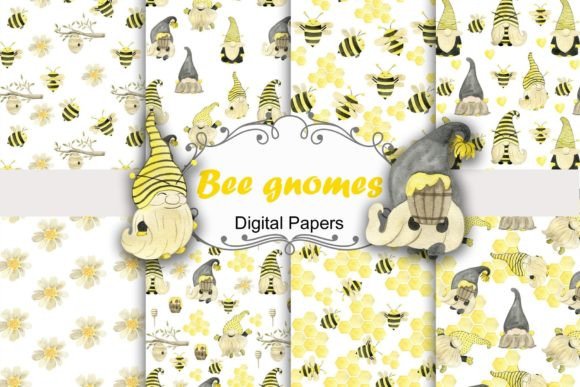
Seamless Patterns with Bee Gnomes represent a distinctive fusion of whimsy, craftsmanship, and digital utility—designed not just as decorative elements, but as functional design assets rooted in watercolor artistry and thoughtful scalability. At their core, these patterns feature hand-painted watercolor bee gnomes: charming, softly textured characters rendered with delicate pigment blooms, subtle granulation, and gentle organic edges. Unlike vector-based or digitally generated illustrations, the watercolor origin imparts warmth, authenticity, and tactile nuance—qualities that resonate strongly in today’s design landscape where consumers increasingly value handmade aesthetics and emotional resonance.
What Makes These Seamless Patterns Functionally Distinct?
The term “seamless” is often used loosely—but in this context, it carries precise technical meaning. Each of the eight included JPEG files measures 16 by 16 inches at 300 DPI (4800×4800 pixels), ensuring high-resolution fidelity for both print and large-scale applications. More importantly, every pattern tile has been meticulously edited to eliminate visible seams when repeated horizontally or vertically. This isn’t achieved through simple cloning or automated tiling tools; rather, each composition was built from the ground up using manual edge-matching techniques—balancing color transitions, element placement, and negative space so that adjacent tiles align naturally, without ghosting, misalignment, or abrupt tonal shifts.
This level of craftsmanship matters across disciplines. For textile designers developing fabric collections, seamless repetition ensures continuity across yardage—no awkward breaks where motifs collide mid-drape. For stationery creators producing greeting cards or wedding suites, the same pattern can scale from a subtle border to a full-page background without requiring re-cropping or interpolation. And for educators designing classroom visuals or printable learning aids, the ability to generate infinite-size backgrounds means adaptable layouts for posters, flashcards, or interactive PDFs—without pixelation or licensing ambiguity.
Practical Applications Across Industries
The versatility of Seamless Patterns with Bee Gnomes emerges most clearly when viewed through real-world implementation. Below are observed use cases—drawn from actual creative workflows—that highlight adaptability beyond generic “scrapbooking” or “background” labels.
- Apparel & Baby Clothing: Designers have successfully printed these patterns onto organic cotton interlock and bamboo jersey for baby onesies and toddler rompers. The softness of the watercolor aesthetic complements gentle garment textures, while the bee gnome motif appeals to gender-neutral, nature-inspired parenting trends. Because the tiles repeat flawlessly, pattern matching across shoulder seams or sleeve hems remains consistent—even on curved surfaces—reducing production waste during cutting.
- Digital Art & Mixed Media: Illustrators layer individual bee gnome elements (extracted via careful masking) over hand-drawn line art or photography to create hybrid compositions. The watercolor grain interacts organically with scanned pencil textures, avoiding the “flat” look common with stock PNGs. Some artists use the full-pattern JPEGs as underlays in Procreate or Photoshop, lowering opacity to guide color blocking or compositional rhythm.
- Paper Goods & Packaging: Small-batch stationery brands apply these patterns to foil-stamped gift tags, kraft paper wrapping sheets, and die-cut sticker sheets. The 300 DPI resolution supports crisp embossing and fine-line foil registration. Notably, users report that the subtle variation in watercolor saturation across the tile helps mask minor inconsistencies in uncoated paper absorption—unlike uniform digital gradients, which can emphasize paper flaws.
- Educational Resources: Early childhood educators convert sections of the patterns into printable alphabet charts, counting mats, or emotion cards—using the bee gnomes as visual anchors for social-emotional learning. Because the imagery avoids overt anthropomorphism (no exaggerated facial expressions or cartoonish proportions), it supports inclusive interpretation across diverse cultural contexts and neurodiverse learners.
Technical Considerations for Optimal Use
While accessibility and ease-of-use are central to this kit’s design, informed application requires awareness of several technical parameters:
- Color Mode & Consistency: All files are delivered in RGB mode, optimized for screen-based design and digital printing services. For offset or silkscreen production, designers should convert to CMYK only after soft-proofing—particularly given the watercolor’s reliance on subtle cyan/magenta balance for natural-looking yellows and browns.
- Scaling Integrity: Though the base tile is 4800×4800 px, resizing beyond 200% in raster editors may introduce interpolation artifacts. Best practice is to tile first (using native pattern-fill functions in Adobe Illustrator, Affinity Designer, or even CSS background-repeat), then scale the final composite canvas—not the source JPEG itself.
- Licensing Scope: These digital papers are licensed for both personal and commercial use—including resale of physical end products (e.g., printed notebooks, sewn quilts, or embroidered patches). However, redistribution of the raw JPEG files—as standalone digital assets or within competing pattern bundles—is expressly prohibited. This protects the integrity of the original watercolor technique and respects the labor-intensive process behind each tile.
Why Watercolor Bee Gnomes Stand Out in a Crowded Market
Amidst an abundance of digital patterns—many algorithmically generated or sourced from clipart libraries—the intentional use of watercolor elevates this collection beyond trend-driven decoration. Watercolor inherently resists perfection: its capillary flow, pigment sedimentation, and paper tooth interaction produce micro-variations no two tiles replicate identically. When translated into a seamless format, this creates a paradoxical effect—mathematical repetition paired with organic unpredictability. End users perceive this as “alive” texture, not static repetition.
Moreover, the choice of bee gnomes as subject matter reflects deeper thematic alignment with contemporary values. Bees symbolize collaboration, ecological stewardship, and quiet resilience—themes increasingly embedded in branding for sustainable fashion, eco-conscious education, and wellness-oriented products. Gnomes, meanwhile, carry cross-cultural associations with guardianship, earth wisdom, and gentle magic—making them accessible to secular and spiritual audiences alike. Together, they form a motif that feels both timeless and timely, neither overly childish nor excessively ornate.
Integration Into Existing Workflows
Adopting Seamless Patterns with Bee Gnomes rarely demands workflow overhauls. Most users integrate them incrementally:
- For Adobe Creative Cloud users: Drag-and-drop the JPEG into Photoshop or Illustrator, then define as a pattern swatch (Edit > Define Pattern). Use the Pattern Options panel to adjust spacing and randomness—especially useful when simulating hand-blocked textile effects.
- For Canva or Cricut Design Space users: Upload as custom uploads, then apply as background fills. Since the files are high-DPI, they retain clarity even when stretched across multi-page documents or large-format vinyl cut files.
- For educators using Google Slides or PowerPoint: Insert as full-slide backgrounds, then lock aspect ratio before resizing. The uniform dimensions (16×16 inches) simplify batch creation of themed slide decks—e.g., a “Pollinator Science” unit where every slide shares cohesive visual language without distracting complexity.
Thoughtful Design Beyond Aesthetics
What distinguishes this kit from superficially similar offerings is its attention to contextual harmony. The watercolor bee gnomes avoid saturated neon palettes or hyper-stylized linework—instead favoring muted ochres, sage greens, dusty lavenders, and warm greys. This restrained palette ensures compatibility with existing brand systems, whether applied to minimalist Scandinavian nursery decor or richly layered botanical journals. It also supports accessibility: sufficient contrast between gnome forms and background fields meets WCAG 2.1 AA guidelines for non-text content when used at recommended scale.
Equally important is the absence of cultural appropriation or stereotyping. The gnomes wear simple tunics and cloaks inspired by European folk traditions—but without caricatured features, exaggerated proportions, or coded symbolism. Their bee companions are anatomically respectful (accurate wing veining, segmented bodies), reflecting entomological observation rather than cartoon shorthand. This grounding in respect and accuracy expands usability across global markets and educational settings where representation and factual integrity are paramount.
Final Observations for Practitioners
Seamless Patterns with Bee Gnomes succeed not because they solve one narrow problem, but because they operate at the intersection of multiple needs: technical reliability for production, aesthetic warmth for emotional connection, and conceptual depth for meaningful storytelling. They invite iteration—not as static backdrops, but as living components within larger systems of making. A textile designer might isolate a single bee gnome to develop an embroidery motif; a teacher could trace outlines for tactile sandpaper letters; a packaging developer might invert colors to create debossed foil templates.
Ultimately, the value lies less in what the files *are*, and more in what they *enable*: quieter moments of creativity, more confident experimentation with scale and medium, and consistent visual language across touchpoints—whether that’s a child’s handmade card, a boutique’s seasonal label, or a university’s sustainability campaign. When digital resources honor both craft tradition and modern utility, they transcend trend and become infrastructure—for makers, educators, and storytellers alike.