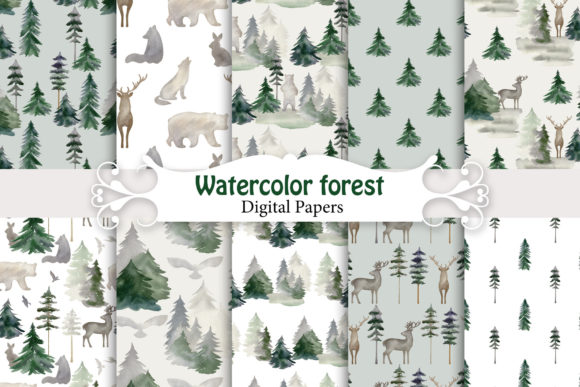
Watercolor Forest Seamless Patterns
There’s a quiet shift happening across creative workflows—from independent designers building brand identities to educators crafting classroom materials, from small-batch apparel makers to journaling enthusiasts seeking tactile warmth in digital tools. At the center of this shift is a renewed appreciation for texture, organic nuance, and visual continuity—qualities that Watercolor Forest Seamless Patterns deliver with both subtlety and versatility.
What Makes These Patterns More Than Just Backgrounds?
These aren’t generic forest motifs or AI-generated foliage loops. Each pattern in the collection is built from hand-painted watercolor elements—soft washes of moss green, misty greys, sunlit ochres, and deep forest umbers—then digitally refined into truly seamless 16×16 inch JPEG files (4800×4800 px at 300 DPI). That resolution means they scale cleanly for print: large-format wall art, letterpress stationery, fabric swatches, or packaging mockups. And because they’re seamless, you can tile them infinitely—horizontally, vertically, or diagonally—without visible seams or repetition fatigue.
This technical precision meets expressive intent. Unlike rigid vector repeats or pixel-perfect geometric tiles, these patterns retain the gentle unpredictability of real watercolor: subtle granulation, soft edges, and layered transparency that mimics how pigment behaves on paper. That authenticity resonates where digital fatigue is high—especially among users who value craft-informed design without sacrificing efficiency.
Why Seamless Watercolor Patterns Fit Modern Creative Needs
Today’s creators juggle multiple roles and platforms. A freelance illustrator might need the same forest motif for a client’s Instagram story background, a limited-run notebook cover, and a printable planner page—all within one afternoon. A boutique stationery brand may source textures for web banners, product labels, and seasonal greeting cards, all requiring consistent tone but varying dimensions and resolutions.
That’s where seamlessness becomes functional—not just aesthetic. Instead of hunting for matching variants or manually editing edges, users start with one high-res file and extend it as needed. No cropping compromises. No scaling artifacts. No licensing ambiguity. It’s a small but meaningful reduction in friction—one that compounds across dozens of projects per year.
This aligns with broader workflow trends: modular asset libraries, reusable design systems, and cross-medium consistency. It also reflects shifting user expectations around digital tools—not just “does it work?” but “does it feel intentional? Does it save me time *and* preserve my voice?”
From Scrapbooking to Sustainable Branding
Historically, watercolor textures lived in analog spaces: handmade cards, zine covers, textile dye tests. But as physical and digital practices converge, those same qualities are being re-adopted—not as nostalgia, but as strategic differentiators. Consider:
- Scrapbooking & Journaling: Printers now support high-DPI matte paper stocks that render watercolor grain beautifully. These patterns provide cohesive backdrops for photo collages or handwritten reflections—without competing with content.
- Web Design: Subtle tiled backgrounds add depth to hero sections or blog headers while maintaining accessibility contrast. Because they’re soft-edged and low-saturation, they don’t overwhelm text or distract from CTAs.
- Apparel & Product Design: When printed on organic cotton or linen, watercolor forest motifs translate with quiet sophistication—ideal for eco-conscious brands avoiding loud graphics or synthetic-looking repeats.
- Educational Materials: Teachers use them as printable worksheet borders or presentation slide backgrounds—calming visuals that support focus without infantilizing content.
What ties these uses together isn’t just aesthetics—it’s intentionality. A seamless watercolor forest pattern doesn’t shout. It supports. It unifies. It adapts.
How Resolution and Format Shape Real-World Use
The choice of 4800×4800 px JPEGs at 300 DPI wasn’t arbitrary. It responds directly to practical constraints faced by working creatives:
- Print readiness: Covers standard poster sizes (24×36”, 30×40”) with room to crop or bleed. Also fits common fabric printing specs (e.g., Spoonflower’s minimum 3600 px dimension).
- Software compatibility: JPEGs open instantly in Photoshop, Affinity Designer, Canva Pro, Figma (via plugins), and even basic editors like Preview or Paint.NET—no special software required.
- File management simplicity: Ten distinct patterns—enough variety to avoid repetition across projects, but few enough to keep libraries lean and searchable.
Notably, these files don’t require subscription access, plugin installation, or cloud syncing. They’re downloaded, stored locally, and used immediately—valuable for professionals managing client assets under strict IP guidelines or educators with limited IT support.
Design Ethics Meet Everyday Utility
There’s growing awareness—among buyers and creators alike—about the hidden labor behind “free” digital assets. Many low-cost or free pattern packs rely on automated generation, lack true seamlessness, or embed restrictive licenses that limit commercial use. Others offer high-res files but no clarity about color profiles, intended output media, or scalability limits.
In contrast, Watercolor Forest Seamless Patterns prioritize transparency and usability. The 10 included images were tested for tiling behavior across multiple applications and output types. They’re sRGB-encoded for predictable screen display and compatible with CMYK conversion workflows for professional print. There’s no upsell for “extended licenses”—commercial use is included, whether for selling prints, designing Shopify themes, or producing physical goods.
This approach reflects a maturing market: users increasingly weigh long-term utility over short-term savings. One well-documented, responsibly sized, ethically licensed pack often replaces five fragmented downloads—and saves hours of troubleshooting.
Where This Fits in the Larger Creative Landscape
Watercolor textures aren’t trending because they’re new—they’re resurging because they meet evolving needs. As algorithm-driven design grows more prevalent, many professionals seek counterpoints: human-made imperfection, material honesty, and visual calm. At the same time, sustainability pressures push designers toward multipurpose assets—ones that serve print and screen, personal and client work, analog and digital outputs—without duplication or waste.
Seamless watercolor forest papers sit at that intersection. They’re not a shortcut—they’re a thoughtful tool. Their strength lies in restraint: no excessive layering, no forced vibrancy, no artificial symmetry. Instead, they offer rhythm through variation—lighter washes next to deeper tones, clustered leaves beside open negative space—creating cohesion that feels earned, not engineered.
Getting Started Is Intentional, Not Complicated
You don’t need advanced software to begin. Try opening one JPEG in your preferred editor and duplicating the canvas horizontally—then nudging the second instance into place. Watch how the forest floor, canopy layers, or mist gradients flow uninterrupted. Then test it at 50% opacity behind typography. Or import it into a desktop publishing tool and set it as a master page background.
For apparel designers: sample how the pattern interacts with garment seams by tiling across a mockup template. For journal lovers: print a single tile on heavyweight paper, then cut and bind it into a custom cover. For marketers: use one pattern consistently across email headers, social banners, and downloadable lead magnets to reinforce visual recognition without monotony.
Each use reveals something different about the pattern—not just what it looks like, but how it behaves. And that behavior—predictable, adaptable, grounded—is what makes it useful across years, not just projects.
If you’re evaluating whether these patterns fit your current or upcoming work, consider where repetition currently causes friction: Are you resizing or patching backgrounds? Re-coloring motifs for different mediums? Searching for textures that feel cohesive but not sterile? That’s where Watercolor Forest Seamless Patterns earn their place—not as decoration, but as infrastructure.
Please send a message if you have any questions. Thank you.