7 Vector Patterns with Ornamental Feather: Stylish, Scalable Boho Design for Modern Creators
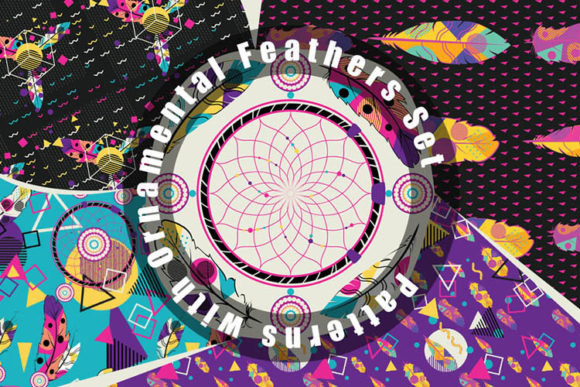
Designers, marketers, and small business owners increasingly seek assets that balance visual richness with technical flexibility—especially when launching products, rebranding websites, or crafting social content. The 7 Vector Patterns with Ornamental Feather collection meets that need precisely: a curated set of abstract boho pattern swatches in Adobe Illustrator (AI) format, each built around stylized, decorative feathers rendered in vibrant, harmonious color palettes. These aren’t clipart-style motifs or pixelated repeats—they’re mathematically precise vector patterns, fully editable, infinitely scalable, and purpose-built for professional workflows.
Why Ornamental Feathers Resonate Now—Beyond Aesthetic Appeal
Feathers have long carried symbolic weight across cultures—freedom, lightness, transformation, connection to nature. Today, that symbolism aligns with broader cultural shifts: a growing preference for designs that feel intentional, human-scaled, and emotionally resonant—not just sleek or minimal. Ornamental feathers, especially when stylized rather than photorealistic, offer texture without clutter, movement without chaos. They bridge organic warmth and digital precision—a quiet response to the fatigue many feel toward over-polished, algorithm-driven visuals.
This isn’t about nostalgia. It’s about relevance. In 2024, consumers respond more readily to brands that signal authenticity through thoughtful detail—like a subtle feather motif woven into packaging, a background pattern on an educator’s workshop slide deck, or a custom textile repeat for an indie apparel line. The 7 Vector Patterns with Ornamental Feather collection supports that intentionality: each pattern is distinct in rhythm and density, yet unified by cohesive color logic and hand-drawn sensibility translated into vector form.
How These Patterns Fit Real Creative Workflows
Unlike raster-based repeats or generic seamless tiles, these AI files are native to industry-standard design software. That means users can:
- Adjust individual feather strokes, colors, or spacing without quality loss;
- Swap Pantone swatches or convert to CMYK/RGB with full control;
- Scale patterns to wrap a product mockup, fill a large-format print, or tile across a website hero section—all without pixelation;
- Isolate single feather elements to use as standalone icons or compositional accents.
A freelance graphic designer recently used one of the patterns to refresh a yoga studio’s seasonal newsletter template—applying it as a subtle border element behind headlines. Because the file was vector-based and layered cleanly, she adjusted the saturation to match the studio’s new earth-toned palette in under two minutes. A ceramicist used another pattern as a repeat for her online shop’s “limited edition” banner, then extracted a single feather glyph to stamp onto packaging labels. These aren’t edge cases—they reflect how professionals actually work today: fast, iterative, cross-platform, and brand-consistent.
The Shift Toward Editable, Ethical Design Assets
There’s been a quiet but steady pivot away from “plug-and-play” design kits that lock users into rigid layouts or non-editable layers. Designers, educators, and small teams now prioritize assets they can adapt—not just deploy. This shift reflects both practical needs (tight deadlines, evolving brand guidelines) and ethical considerations: knowing exactly what you’re licensing, how it was made, and whether it respects creative labor.
The 7 Vector Patterns with Ornamental Feather collection was developed with that mindset. Each pattern is original—no stock-derived elements—and structured with clear layer naming and grouped objects in Illustrator. There are no hidden raster effects, embedded fonts, or locked layers. That transparency saves time during handoff, reduces revision cycles, and builds confidence when sharing files with clients or collaborators.
Boho Abstraction Meets Contemporary Color Strategy
“Boho” often conjures associations with maximalism or dated 2010s palettes—but this collection reinterprets the spirit for current taste. The seven patterns use restrained, contemporary color systems: muted terracotta paired with slate blue; warm ochre against soft sage; deep indigo layered with chalky peach. None rely on neon brightness or oversaturated gradients. Instead, they achieve vibrancy through contrast, balance, and careful saturation control—qualities that translate well across digital screens, printed materials, and physical products.
That color discipline matters. A marketer running A/B tests on email headers found that versions using one of the feather patterns—with its gentle tonal variation—had higher scroll depth and click-through rates than those with high-contrast geometric patterns. Why? The ornamental feather motif drew attention without triggering visual fatigue. It invited closer look, not quick dismissal.
Practical Use Cases Across Roles
These patterns serve diverse needs—not just “designers.” Consider how they function outside traditional graphic design contexts:
- Educators use them as subtle backgrounds for presentation slides—adding visual interest without distracting from lesson content;
- Bloggers and content creators apply them as section dividers or featured image overlays, reinforcing brand personality without custom illustration;
- Small business owners integrate them into Canva templates, Shopify banners, or Instagram story frames—maintaining cohesion across touchpoints;
- Product designers test them on fabric swatches or packaging mockups before committing to physical production;
- Freelancers build custom proposals or pitch decks where distinctive yet professional visuals help differentiate their offering.
None require advanced Illustrator skills. Even users who primarily work in Figma or Photoshop can copy-paste vector art directly (with fidelity) or export clean PNG/SVG exports at any size.
What Makes These Patterns Stand Apart From Generic Alternatives
Many free or low-cost pattern libraries suffer from repetition—same base shape, same spacing logic, same flat color fills. The 7 Vector Patterns with Ornamental Feather collection avoids that trap. Each of the seven swatches explores a different compositional principle:
- One uses asymmetric feather clusters with rhythmic negative space;
- Another layers translucent feather silhouettes for depth;
- A third employs staggered line weights to suggest motion;
- Two feature intentional “imperfections”—slight rotation variance or organic stroke taper—to avoid mechanical uniformity;
- The remaining patterns explore scale contrast, monochrome-with-accent treatment, and interlocking geometry.
This variety ensures users aren’t reaching for the same pattern repeatedly. It also supports storytelling: a softer, looser pattern might suit a wellness brand, while a tighter, bolder repeat could reinforce energy for a creative workshop series.
Looking Ahead: Pattern as Infrastructure, Not Decoration
As tools like AI-assisted design become more common, the value of human-crafted, editable assets grows—not shrinks. Algorithms generate patterns quickly, but rarely with intentionality around context, color psychology, or technical adaptability. The 7 Vector Patterns with Ornamental Feather collection represents a different approach: pattern as infrastructure. Something reliable, expressive, and ready to support real work—not replace it.
That’s why professionals keep returning to well-structured vector sets like this one. They don’t chase trends; they enable clarity. They don’t add noise; they support voice. And in a landscape where attention is scarce and authenticity is earned, that kind of quiet utility matters more than ever.