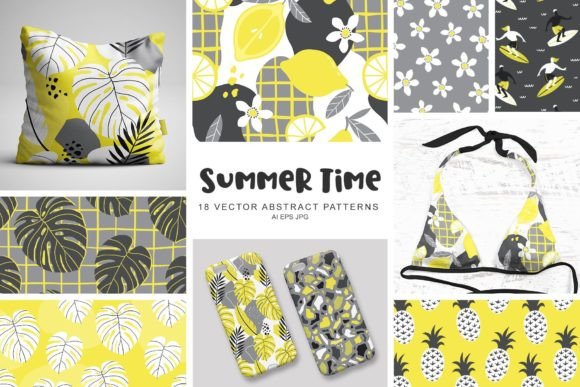
Summer Time Patterns Set: Seamless Design for Modern Creative Workflows
Designers, product developers, and brand strategists are increasingly turning to curated, production-ready pattern libraries—not as decorative afterthoughts, but as strategic creative infrastructure. The Summer Time Patterns Set exemplifies this shift: a thoughtfully composed collection of 18 modern abstract seamless patterns that distill the essence of summer into scalable, versatile vector assets. More than seasonal eye candy, it reflects how contemporary design workflows prioritize speed, consistency, and cross-platform adaptability—without sacrificing aesthetic intentionality.
A Pattern Library Built for Real-World Application
The Summer Time Patterns Set isn’t a mood board—it’s a functional toolkit. Each of its 18 seamless patterns is delivered in three essential formats: Adobe Illustrator (.ai), EPS (for broad vector compatibility), and high-resolution JPG (5000×5000 px). This tri-format structure acknowledges the reality of today’s creative ecosystem: designers move fluidly between vector-based branding work, print production pipelines, and digital mockup environments—all within a single project cycle.
What sets this set apart is its intentional curation. It includes bright tropical leaves rendered with clean line work, stylized fruits with playful negative space, naive floral motifs that balance charm and minimalism, subtle animal-print abstractions (avoiding literal mimicry), terrazzo textures translated into flat vector geometry, and refined plaid variations that nod to heritage while feeling unmistakably current. These aren’t isolated motifs—they’re harmonized through shared color temperature, scale logic, and rhythmic density, ensuring visual cohesion across applications without requiring manual adjustment.
Why Seamless Patterns Are Gaining Strategic Weight
Seamless patterns have evolved from background embellishments into foundational brand elements—especially in direct-to-consumer (DTC) and lifestyle markets. Consider swimwear labels launching limited-edition collections: a cohesive pattern set enables them to deploy the same tropical leaf motif across fabric yardage, packaging inserts, Instagram story templates, and even QR code backgrounds—creating instant recognition without repeating photographic assets. Similarly, stationery brands use seamless patterns to unify notebook covers, sticker sheets, and digital planner templates, reinforcing tactile-to-digital continuity.
This trend aligns with broader consumer expectations. Today’s audience doesn’t just buy a t-shirt—they engage with a *sensibility*. A terrazzo-inspired pattern on leggings, echoed in matching phone case artwork and reusable shopping bag linings, communicates intentionality and brand fluency. The Summer Time Patterns Set supports that fluency by offering textures and motifs that translate equally well to woven textiles, heat-transfer vinyl, screen printing, and digital wallpaper engines—no re-rasterization or scaling compromises required.
Meeting Evolving Production Demands
Freelance surface designers and in-house creative teams alike face tighter deadlines and broader deliverable scopes. Clients now routinely request “pattern + palette + mockups + social assets” in a single brief. In that context, waiting to build a custom repeat from scratch—or licensing disparate patterns with mismatched DPI, color profiles, or tile boundaries—introduces avoidable friction.
The Summer Time Patterns Set addresses this by embedding technical rigor into its foundation. All patterns are built using non-destructive Illustrator paths, with tile boundaries precisely aligned to artboard edges—a necessity for predictable scaling in textile CAD software like Optitex or Browzwear. The EPS files retain editable layers and swatches, supporting quick recoloring for A/B testing or seasonal palette shifts. Even the JPG exports are provided at 300 PPI, eliminating guesswork for print-on-demand platforms like Printful or Gelato.
Beyond Summer: How Seasonal Sets Reflect Broader Creative Shifts
While named for its thematic focus, the Summer Time Patterns Set participates in a larger movement toward modular, context-aware design systems. Just as UI designers rely on component libraries (buttons, cards, navigation bars), surface designers now treat patterns as reusable primitives—each designed to function across scales, substrates, and cultural contexts.
Notice how the set avoids overly literal interpretations: no photorealistic pineapples or clichéd palm silhouettes. Instead, it offers abstraction with resonance—fruits reduced to bold silhouettes with organic weight; leaves simplified into rhythmic curves; terrazzo grains spaced to read clearly at both 2-inch and 20-foot scales. This approach mirrors developments in generative design tools, where artists prompt algorithms not for finished images, but for adaptable stylistic parameters—tone, rhythm, contrast, texture language. The Summer Time Patterns Set delivers that same kind of stylistic scaffolding, ready for human direction.
Practical Integration Across Industries
Here’s how professionals are applying it today:
- Fashion & Apparel Entrepreneurs: Using the naive flower pattern as a base for silk scarf prototypes—then extracting individual blooms to create embroidery digitizing files for limited-run caps.
- Stationery Brands: Layering the plaid texture beneath hand-lettered quotes in Canva, then exporting as transparent PNGs for printable quote cards and Instagram carousel assets.
- Interior Design Studios: Importing the terrazzo vector into SketchUp via plugins to preview how the pattern reads on 3D-rendered accent walls before ordering physical samples.
- Educational Content Creators: Teaching pattern construction in Adobe Illustrator courses—using the included AI files as reverse-engineering exercises to demonstrate tile alignment, path optimization, and global swatch management.
Each use case underscores a shared priority: reducing iteration time while preserving creative control. That balance is no longer optional—it’s expected.
Aligning With Sustainable & Scalable Practices
Sustainability in design extends beyond material choices—it includes workflow efficiency. Reusing a single, well-built pattern asset across ten SKUs reduces redundant file creation, version confusion, and color-matching errors in production. The Summer Time Patterns Set supports this by delivering assets that meet industry-standard technical benchmarks out of the box.
For marketers building campaign assets, having a unified summer pattern language means fewer freelance revisions when adapting from web banners to trade show backdrops. For product designers iterating on swimwear lines, the ability to swap between fruit and leaf motifs—while maintaining identical tile dimensions and bleed zones—accelerates sampling cycles. That operational efficiency translates directly into lower carbon cost per launch and faster responsiveness to real-time consumer feedback.
Looking Ahead: Patterns as Narrative Anchors
As AR commerce, spatial computing, and AI-assisted personalization mature, patterns will play an increasingly vital role—not just as decoration, but as narrative anchors. A customer scanning a backpack with their phone might trigger an animated version of the tropical leaf pattern blooming across their screen, linking physical product to digital storytelling. The vector foundation of the Summer Time Patterns Set makes such transitions technically viable: scalable paths animate smoothly; embedded swatches sync with dynamic color APIs; tile logic remains intact when converted to WebGL shaders.
This isn’t speculative futurism—it’s logical extension. Brands already use consistent pattern languages to signal values (e.g., botanical motifs for wellness, geometric repeats for tech-forwardness). What’s changing is the expectation that those languages operate seamlessly—not just visually, but functionally—across every touchpoint a customer encounters.
In that landscape, the Summer Time Patterns Set represents more than convenience. It’s evidence of a maturing discipline: one where pattern design is recognized as infrastructure, not ornamentation—and where thoughtful curation meets uncompromising technical execution. For professionals building brands, products, and experiences rooted in authenticity and agility, it’s not just timely. It’s necessary.