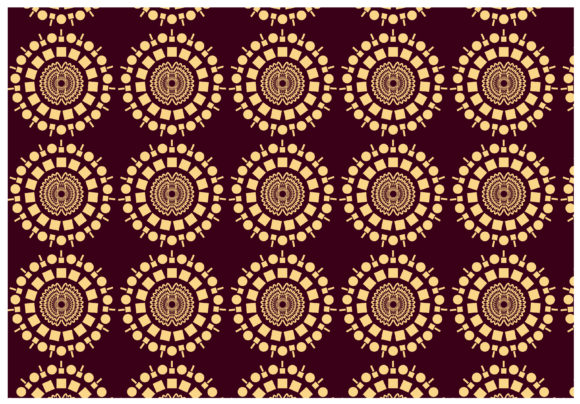
Mandala Seamless Geometric Patterns: Precision, Flexibility, and Creative Scalability in Modern Design
At the intersection of ancient symbolism and contemporary digital craftsmanship lies a quietly transformative resource: Mandala seamless geometric patterns. Far beyond decorative flourishes, these designs embody a rare fusion of mathematical harmony, cultural resonance, and technical versatility. What distinguishes them from generic repeat tiles is not just aesthetic appeal—but their engineered scalability, editable fidelity, and adaptability across physical and digital media. A collection of 100 high-resolution, editable vector files—delivered in EPS and JPEG formats at 300 DPI, RGB color space—offers more than convenience. It delivers foundational design infrastructure.
Why Seamless Geometry Matters in Real-World Applications
Seamlessness isn’t merely about invisibility at tile edges—it’s about functional integrity across scale and context. When a pattern repeats without visible seams, it eliminates visual disruption in large-format applications: think wall murals spanning 12 feet, textile yardage for apparel production, or branded floor graphics in retail environments. Unlike raster-based repeats that pixelate or blur when enlarged, Mandala seamless geometric patterns retain razor-sharp clarity at any dimension because they’re built in vector format. This means a motif measuring 1 inch on screen can expand to cover an entire exhibition hall—without loss of definition or color accuracy.
Consider a university design lab prototyping sustainable packaging. Students use one of the vector files to wrap a 3D mockup of a biodegradable container. Later, the same file scales precisely to fit a 6-foot-wide trade show banner—no reworking, no interpolation artifacts, no color shifts. That continuity stems from the underlying vector architecture: paths, anchors, and Bézier curves—not pixels.
The Editable Vector Advantage: Beyond Static Decoration
The phrase “all editable file” carries substantive weight. In the included EPS source files, every element—circles, polygons, interlocking lines, radial gradients—is fully selectable and modifiable within Adobe Illustrator (or compatible vector editors). You’re not limited to swapping a single swatch. You can:
- Isolate individual layers to mute or emphasize specific geometric tiers—such as suppressing outer concentric rings while retaining the central mandala core;
- Adjust stroke weights globally or per path, transforming a delicate linework motif into a bold architectural stencil;
- Reassign colors using global swatches, enabling rapid brand alignment—for example, shifting a neutral gray-and-ivory pattern to match a client’s Pantone 2945 C + 1235 C palette;
- Apply non-destructive effects like opacity masks or blending modes to create depth without flattening layers;
- Export subsets as SVG for web use or PDF/X-4 for print-ready press files.
This level of control transforms the collection from a static asset library into a responsive design system. A graphic designer working on a wellness app interface might extract a simplified 8-point radial shape, convert it to a scalable icon, and animate its rotation via CSS. Simultaneously, a textile engineer could import the same base geometry into CAD software to calculate weave density and thread tension for jacquard loom programming.
Diverse User Pathways: How Different Professionals Leverage These Patterns
What makes Mandala seamless geometric patterns uniquely cross-disciplinary is how naturally they integrate into distinct workflows—each user extracting different value from the same underlying files.
Educators and Curriculum Developers
In STEM and art integration units, teachers use the vector files to demonstrate symmetry groups (p4m, p6m), tessellation logic, and radial transformation matrices. Students manipulate anchor points to observe how altering one node propagates changes across rotational copies—making abstract group theory tactile and visible. The editable nature invites inquiry: “What happens if we change the angle of this wedge from 45° to 30°? Does the pattern still tile seamlessly?”
Hobbyists and Makers
A woodburning artisan imports a low-contrast mandala pattern into laser-cutting software, adjusts line thickness for optimal burn depth, then etches it onto a walnut cutting board. Because the file is vector-based and infinitely resizable, the same design adapts flawlessly to a 4-inch coaster or a 24-inch serving tray—no redrawing required. Similarly, embroidery enthusiasts convert paths to stitch files using Illustrator’s native export to PES or DST formats, preserving clean intersections critical for satin-stitch stability.
Business Owners and Brand Strategists
Small-batch candle makers apply subtle mandala repeats as foil-stamped backgrounds on matte-black labels. The 300 DPI JPEG ensures crispness during digital printing; the EPS allows future adaptation for embossed business cards or Instagram story templates. Crucially, because all colors are editable, seasonal rebranding—say, shifting from winter indigo-to-silver to spring sage-to-terracotta—takes minutes, not days.
Technical Considerations for Optimal Use
While the flexibility is extensive, informed usage prevents common pitfalls. First, understand the distinction between the EPS master files and the JPEG derivatives: EPS retains full editability and scalability; JPEGs are flattened, raster previews intended for quick reference or non-vector workflows (e.g., PowerPoint presentations or basic photo editors). Always begin edits in EPS.
Second, respect color mode intent. The files ship in RGB—not CMYK—because RGB offers broader gamut fidelity for screen-based work and provides smoother transitions for digital displays, projections, and LED signage. For commercial offset printing, convert to CMYK *after* final edits, using Illustrator’s “Convert to Profile” with appropriate ICC profiles (e.g., ISO Coated v2) to preserve luminance and saturation integrity.
Third, leverage Illustrator’s “Pattern Options” panel judiciously. Though the patterns are pre-built as seamless tiles, modifying tile width/height manually can break alignment if not paired with “Size Tile to Art” and “Move Tile with Art” toggles. When customizing repeat dimensions, always preview in Outline mode (Ctrl+Y) to verify path continuity across tile boundaries.
Design Philosophy Embedded in Geometry
These patterns do more than fill space—they invite intentionality. Traditional mandalas function as meditative focal points, organizing chaos into centered order. Their geometric iterations translate that principle into structural language: balanced ratios, nested symmetry, and recursive subdivision. A hexagonal mandala pattern, for instance, echoes honeycomb efficiency and molecular lattices; a square-grid variant resonates with architectural blueprints and pixel grids.
This isn’t ornamentation for ornamentation’s sake. When a healthcare clinic uses a soft, low-contrast mandala repeat on waiting room wallpaper, the inherent visual rhythm supports environmental calm—backed by studies on pattern complexity and autonomic nervous system response. When an edtech platform embeds subtle mandala geometry into its UI loading animation, the radial motion cues progress and completion, leveraging ingrained cognitive associations with cyclical wholeness.
Practical Implementation Across Media
Real-world viability hinges on tested output pathways. Here’s how professionals consistently achieve reliable results:
- Large-Format Printing: Export EPS to PDF/X-4 with embedded fonts (none required here) and high-res images. Confirm bleed settings match printer specs—most wide-format devices accept native Illustrator files directly.
- Web & App Integration: Use Illustrator’s “Export for Screens” to generate SVG (for responsive icons) and optimized PNG-24 (for hero section backgrounds). Enable “Responsive” and “Align to Pixel Grid” only for UI elements under 100px.
- Textile & Surface Design: Import EPS into programs like PatternLab or Kaledo. Adjust repeat unit size to match fabric width (e.g., 130 cm for fashion knits) and validate with a “mirror repeat” test to catch asymmetry.
- 3D Modeling Prep: Copy vector paths into Rhino or Fusion 360 as curves for extrusion or engraving paths. Scale precisely using reference dimensions—no guesswork needed.
Each pathway reaffirms the same truth: the power of Mandala seamless geometric patterns resides not in their origin, but in their reproducibility without degradation—and their capacity to serve both contemplative and computational needs.
Future-Proofing Through Modularity
Design assets age quickly. Trends shift; technologies evolve; platforms impose new constraints. Yet vector-based mandala geometry resists obsolescence. Its modularity allows repurposing across emerging contexts: generative design scripts can randomize rotation angles of individual motifs while preserving overall tiling logic; AI-assisted colorization tools can apply harmonized palettes derived from brand guidelines or natural imagery; AR filters can overlay animated mandala layers onto real-world surfaces using the vector paths as anchor geometry.
More than a download, this collection functions as a living toolkit—one where precision, cultural intelligence, and technical rigor converge. Whether you’re drafting lesson plans, launching a product line, or prototyping immersive experiences, the ability to scale, recolor, and reinterpret with confidence transforms how creativity interfaces with constraint.