Peaches Seamless Patterns Set: A Practical Evaluation for Designers and Creators
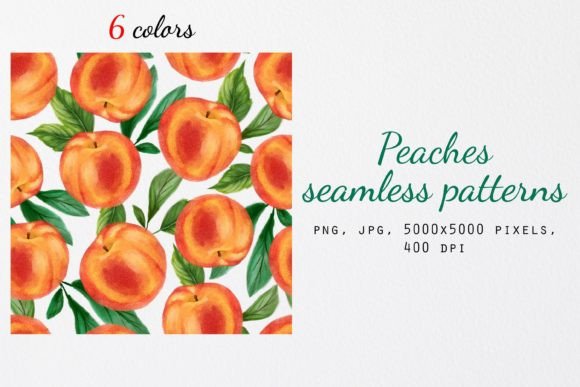
The Peaches Seamless Patterns Set is a curated collection of watercolor-style seamless patterns designed for versatility and visual warmth. Unlike generative or vector-based pattern libraries, this set emphasizes organic texture, soft edges, and natural pigment variation—hallmarks of hand-painted watercolor. What you receive is intentionally focused: one cohesive design delivered in both PNG and JPG formats, with six carefully selected color options. Each JPG file measures 5000 × 5000 pixels at 400 dpi in RGB, supporting high-fidelity use across print and digital contexts.
What Makes This Set Distinctive?
At its core, the Peaches Seamless Patterns Set prioritizes authenticity over automation. The watercolor effect isn’t simulated with filters—it’s captured from real pigment behavior: subtle granulation, gentle blooms, and translucent layering. That means each repeat tile carries nuanced tonal shifts rather than uniform repetition. This quality supports applications where visual richness matters: artisan packaging, boutique stationery, textile mockups, or editorial backgrounds where flat or digitally generated patterns might feel sterile.
The inclusion of six color variants—not just light/dark toggles but thoughtfully balanced palettes—adds flexibility without overwhelming choice. These aren’t arbitrary swatches; they’re harmonized to maintain watercolor integrity across hues. For example, a muted sage option preserves translucency and grain, while a coral variant retains softness instead of flattening into saturation. That consistency reflects intentional curation, not algorithmic recoloring.
How It Compares With Other Pattern Approaches
Seamless patterns fall broadly into three categories: hand-crafted (like the Peaches Seamless Patterns Set), algorithmically generated, and vector-based repeats. Each has tradeoffs depending on your goals.
- Hand-crafted watercolor patterns excel in tactile authenticity and emotional resonance—but require more careful scaling. Because they’re raster-based and resolution-dependent, enlarging beyond their native 5000 × 5000 px may reveal pixelation if pushed past typical print sizes (e.g., large-format wall graphics).
- Algorithmically generated patterns offer near-infinite variation and infinite scalability, but often lack the irregularity that makes watercolor feel alive. They can appear too even, too predictable—especially when viewed up close or printed on textured paper.
- Vector-based seamless patterns scale flawlessly and integrate easily into design workflows like Adobe Illustrator or Figma. However, replicating true watercolor texture in vector form usually involves heavy raster overlays or complex gradient meshes—adding complexity without guaranteeing the same organic spontaneity.
In short: if your priority is expressive, human-made texture and you’re working within standard print or web dimensions, the Peaches Seamless Patterns Set offers a streamlined, high-quality alternative to heavier or less authentic options.
Realistic Use Cases and Practical Fit
This set works best when applied with intention—not as a background filler, but as a deliberate textural layer. Consider these scenarios:
- Small-batch product packaging: A cosmetics brand launching a limited-edition line might use the peach-toned variant on matte-finish boxes. The watercolor softness complements minimalist typography and conveys craftsmanship without competing visually.
- Digital templates for creators: Canva or Adobe Express template designers sometimes struggle to find seamless patterns that don’t overpower content. The Peaches Seamless Patterns Set’s low-contrast variants serve well as subtle backdrop layers behind text-heavy layouts.
- Print-on-demand textiles: While not intended for industrial-scale fabric printing (which often requires TIFFs or specialized color profiles), the 400 dpi JPGs perform reliably for small-run scarves or tote bags via platforms like Printful or Gelato—provided bleed and repeat alignment are verified in advance.
It’s less suitable for projects requiring extreme scalability (e.g., building wraps or stadium banners), multi-layered pattern blending (where vector modularity is essential), or strict CMYK prepress workflows—since it ships in RGB only.
Strengths and Limitations to Weigh
Strengths:
- High-resolution raster files optimized for common professional uses (web, offset print, POD).
- Consistent watercolor aesthetic across all six color options—no jarring shifts in contrast or grain behavior.
- Lightweight delivery: one design, two formats, six colors. No bloated folders or redundant variations to sort through.
- No licensing ambiguity: intended for commercial use, including client work and resale items, assuming standard terms apply.
Limitations:
- Raster-only format means no native vector editing or infinite rescaling.
- No additional pattern motifs—just the single peaches-themed design. Users seeking variety across themes (e.g., florals, geometrics, abstracts) would need supplementary resources.
- No editable source files (e.g., PSD or Procreate layers), so customizing pigment flow or brush density isn’t possible.
- Color accuracy depends on monitor calibration and output device—especially important for brand-critical applications where Pantone matching is required.
When to Choose This Set—and When to Look Elsewhere
The Peaches Seamless Patterns Set is a strong fit if you value cohesion, speed, and aesthetic fidelity over customization depth. It suits designers who’ve already settled on a watercolor direction and want a polished, production-ready asset—not a toolkit for experimentation.
Conversely, consider alternatives if:
- You need to adapt the pattern dynamically—for instance, adjusting opacity per layer, animating transitions, or integrating with parametric design tools. In those cases, SVG-based or procedural pattern generators may offer more control.
- Your project demands strict color matching (e.g., corporate branding with defined Pantone values). While the six color options are well-chosen, they’re fixed—no hex or Pantone equivalents are provided.
- You’re building a long-term pattern library across multiple styles. A single watercolor set won’t replace broader collections, but it can complement them effectively as a signature element.
Also worth noting: because it includes both PNG (with transparency) and JPG (high-res, no alpha), users gain flexibility in how they layer or composite. The PNG version allows for non-rectangular masking or overlay effects in Photoshop or Figma; the JPG ensures maximum compatibility with older CMS platforms or email clients that don’t render transparency reliably.
Making an Informed Decision
Evaluating pattern resources isn’t just about aesthetics—it’s about workflow alignment. Ask yourself:
- What’s my primary output medium? (Web UI, letterpress, embroidery digitizing?)
- Do I need to modify the pattern’s structure—or is visual character the main requirement?
- How much time do I have to test, adjust, and integrate? Simpler assets like the Peaches Seamless Patterns Set reduce setup friction.
- Does this support—not distract from—the message or product I’m representing?
For many mid-level designers, educators, or indie makers, the balance of quality, clarity, and restraint in the Peaches Seamless Patterns Set makes it a practical anchor—not a catch-all solution, but a reliable starting point for watercolor-driven projects. It doesn’t try to be everything. Instead, it does one thing well: deliver expressive, seamless texture with minimal overhead.
Ultimately, the best pattern resource isn’t the one with the most files or features—it’s the one that integrates smoothly into your process, respects your timeline, and reinforces your intent. If that aligns with what the Peaches Seamless Patterns Set offers, it’s worth your attention. If your needs lean toward scalability, modularity, or cross-media precision, then evaluating vector libraries, generative tools, or custom illustration may be the more appropriate next step.