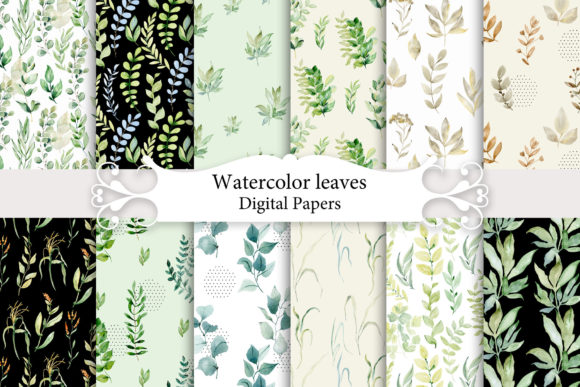
Leaves Seamless Patterns
There’s a quiet shift happening across creative workflows: designers, educators, small business owners, and journaling enthusiasts are moving away from generic digital textures toward intentional, organic surfaces — especially those rooted in natural forms. At the heart of this shift are Leaves Seamless Patterns: a curated collection of digital watercolor papers featuring hand-painted leaf motifs rendered with soft edges, subtle granulation, and authentic pigment behavior. These aren’t clipart leaves or vector silhouettes — they’re tactile, expressive, and built to behave like real watercolor on paper, yet engineered for flawless digital repetition.
Why Seamless Matters — Beyond Aesthetic Preference
“Seamless” isn’t just a technical checkbox — it’s a workflow multiplier. When a pattern repeats without visible seams or alignment hiccups, it eliminates hours of manual tiling, masking, and edge correction. For someone designing custom stationery for a wedding brand, printing fabric for an eco-conscious apparel line, or building a cohesive blog theme with textured backgrounds, seamlessness means consistency at any scale: a 4-inch journal cover or a 48-inch wall mural renders with equal integrity. The 12 included JPEGs — each 4800×4800 pixels at 300 DPI (16×16 inches) — give professionals resolution headroom for high-fidelity print while remaining web-optimized when scaled down. That dual-use flexibility reflects how modern creators operate: fluidly crossing between physical and digital outputs without reworking assets.
Watercolor Texture in a Digital Age — Not Nostalgia, But Necessity
Digital tools have grown sharper, faster, and more precise — but that precision has created a subtle fatigue. Viewers and users increasingly respond to warmth, variation, and human trace. Watercolor, with its inherent unpredictability — blooms, backruns, soft gradients — delivers that authenticity. Unlike flat vector fills or overused stock textures, these digital watercolor papers retain the nuance of pigment interacting with paper fiber. That matters whether you’re illustrating a mindfulness journal page, designing a boutique skincare label, or creating a calming webinar backdrop. It’s not about mimicking analog for its own sake; it’s about leveraging texture as emotional shorthand — softness for reflection, green tones for growth, organic flow for continuity.
Practical Use Across Real Workflows
These patterns thrive where versatility meets intention:
- Scrapbooking & Journaling: Layer a leaf-patterned background beneath handwritten reflections or photo collages — the texture adds depth without competing. Because the pattern tiles seamlessly, it adapts effortlessly to standard journal sizes (A5, 6×8 inches) or custom spreads.
- Web & UI Design: Use as subtle body-background textures, section dividers, or card overlays. At 300 DPI, they hold up under Retina displays when exported at appropriate web resolutions — no pixelation, no awkward repetition lines.
- Apparel & Surface Design: Test prints on fabric swatches or ceramic mugs show how the watercolor grain interacts with material texture. The organic irregularity prevents a “repetitive wallpaper” effect — critical for garments or home goods where pattern fatigue sets in quickly.
- Paper Goods & Branding: Letterpress invitations, foil-stamped notebooks, or limited-run art prints benefit from the richness of watercolor grain. The high-res files allow for crisp detail even when printed large, and the seamless nature ensures repeatable layouts across multi-page booklets or packaging wraps.
- Educational & Therapeutic Materials: Teachers crafting nature-themed lesson plans or therapists developing grounding worksheets find that botanical watercolor textures support focus and calm — without visual clutter. The leaf motif subtly reinforces themes of growth, cycles, and resilience.
How This Fits Into Broader Creative Shifts
This kit responds to three converging trends: first, the rise of *intentional minimalism* — where fewer, higher-quality assets replace cluttered libraries; second, the demand for *cross-platform coherence*, where a brand’s aesthetic holds across Instagram posts, printed brochures, and workshop handouts; and third, the growing expectation for *tactile authenticity* in digital spaces. Consumers notice when a website feels sterile or a product feels mass-produced. A watercolor leaf pattern — imperfect, varied, grounded in natural form — signals care and craft, even when used digitally. It’s not about rejecting technology; it’s about using digital tools to amplify human-centered qualities.
No Over-Editing Required — Designed for Real Work
Each of the 12 patterns is delivered as a ready-to-use JPEG — no layers, no PSD dependencies, no licensing hoops. That simplicity serves creators who value time over complexity: freelancers juggling multiple clients, educators preparing classroom resources after school hours, or small-business owners handling their own design. You don’t need Photoshop mastery to tile them — most design software (from Canva to Affinity Designer to Adobe InDesign) handles seamless tiling intuitively. And because they’re true watercolor scans — not AI-generated approximations — they include natural variations in saturation, drying marks, and pigment settling. That means no two tiled sections look *identical*, preserving the organic feel without manual intervention.
Thoughtful Scale, Intentional Detail
The 16×16 inch / 4800×4800 px dimension wasn’t chosen arbitrarily. It balances practicality and fidelity: large enough to avoid interpolation blur when enlarged for wall art or signage, yet manageable for laptops and tablets during layout work. At 300 DPI, it meets commercial print standards for fine art prints, greeting cards, and packaging — no upsampling needed. And because the patterns are truly seamless, scaling beyond that size is possible through tiling without loss of quality or visual disruption. That scalability supports iterative design: test a pattern at thumbnail size for web UI, then deploy the same file full-bleed for a trade show banner — all from one source.
Who Benefits — And Why It’s Worth Noticing Now
This isn’t niche utility. It’s infrastructure for expression. A freelance graphic designer building a wellness brand’s visual identity gains cohesion across social templates, email headers, and printed meditation cards. A science educator creates engaging plant-biology handouts where the background texture reinforces content without distracting. A maker launching a line of botanical candles uses the same leaf motif across product labels, Shopify banners, and thank-you notes — strengthening recognition without repeating the same image. Even developers embedding textured backgrounds into landing pages appreciate predictable tiling behavior and lightweight JPEG delivery. The common thread? People who value clarity, authenticity, and efficiency — and who refuse to choose between beauty and function.
A Resource That Grows With Your Needs
Unlike single-use graphics, seamless patterns gain value over time. As your projects evolve — from personal journaling to client work to product launches — these files remain relevant. You might start by adding subtle texture to a Canva presentation, then later use the same file as a base layer for a custom fabric print via Spoonflower. Or adapt one pattern into a monochrome version for elegant stationery, another into a duotone for social media stories. Their adaptability lies not in being “all things to all people,” but in being *well-made foundations*: neutral enough to recede, expressive enough to resonate, and technically sound enough to scale.
If you’ve ever spent extra time adjusting tile boundaries, compromised on print resolution to fit a platform’s upload limit, or felt your digital designs lacked the warmth of hand-done work — Leaves Seamless Patterns addresses those friction points directly. They’re not just files. They’re permission to prioritize feeling alongside function, craft alongside convenience, and nature-inspired rhythm alongside modern precision. Please send a message if you have any questions. Thank you.